 how-to
Avoiding Poor Quality Home Renovation: A Checklist
Table of Contents
- Start With a Clear Project Scope and Realistic Budget
- How to Choose a Remodeling Contractor That Delivers
- Home Renovation Contract Checklist: Protect Yourself
- Home Renovation Quality Checklist: What to Inspect
- How to Inspect Renovation Work During and After Construction
- Permits, Building Codes, and Inspection Requirements
- Material Selection and Installation Standards
- What to Do if You're Unhappy With the Work
- Frequently Asked Questions
Last Updated: October 19, 2026
Start With a Clear Project Scope and Realistic Budget
Avoiding poor quality home renovation starts before you hire anyone, with a clear plan and honest budget.
Write down exactly what you want to change, rooms, finishes, features. A vague plan leads to scope creep and cost overruns.
Set a realistic budget by asking contractors what similar projects cost locally, and build in a 10-20% contingency.
How to Choose a Remodeling Contractor That Delivers
Choosing the right contractor is the single biggest factor in avoiding poor quality home renovation. Run a repeatable vetting process before signing anything.
Step 1: Verify the license, not just the claim
Ask for the license number and licensing authority, then look it up in the state database. Confirm it's active, covers your type of work (a general contractor license may not cover electrical or plumbing), and is issued to the exact business entity on your contract.
If they claim licensing isn't required for their trade, ask them to put that in writing.
Step 2: Confirm insurance with certificates, not assurances
Ask for a certificate of insurance (COI) sent directly from the contractor's insurance agent or broker, not a photocopy. It should show:
- General liability coverage with limits appropriate to your project size. A common benchmark is at least $1 million per occurrence, but larger projects warrant higher limits.
- Workers' compensation coverage for every employee who will be on your property. If a worker is injured on your job and the contractor lacks workers' comp, you can be exposed.
- Your address listed as the project location on the certificate, so the policy actually applies to your job.
Call the agent's number on the COI to confirm the policy is current, certificates can be forged or expired.
Step 3: Interrogate references with specific questions
Call at least three references from projects completed in the last 12-18 months, and ask questions that surface problems:
- Did the final cost match the contract, and if not, what changed and why?
- How did the contractor handle the first problem that came up?
- Did the crew show up when promised, and who supervised the site day to day?
Listen for hesitation. "They were fine" is not a reference; "here's what went wrong and how they fixed it" is.
Step 4: Compare written scopes line by line
Don't compare totals; compare scopes line by line: demolition, permit fees, material grades, labor per trade, cleanup, and warranty terms. A bid 30-40% lower often isn't cheaper, it's missing line items that reappear as change orders.
Ask each contractor to break out allowances separately (for example, a tile allowance of $X per square foot), allowances are where budgets quietly blow up.
Step 5: Read the payment schedule as a risk signal
A reputable contractor asks for a modest deposit, commonly 10-25%, then bills at defined milestones. Be cautious of front-loaded schedules or large cash payments with no invoice trail. Payments should be tied to completed, inspectable work, not calendar dates.
Red flags when evaluating contractor bids
Watch for these warning signs in bids:
- Vague estimates. If a bid doesn't itemize labor, materials, and timelines, it's incomplete and can't be compared fairly.
- Lowest price by far. If one bid is 30-40% cheaper than others, ask why. Often it means corners will be cut.
- No written contract. Verbal agreements disappear when problems arise. Insist on everything in writing.
At JB's Construction LLC, we believe constant communication is non-negotiable. You should know what's happening on your project every step of the way.
Home Renovation Contract Checklist: Protect Yourself
A solid contract prevents misunderstandings and gives you recourse if work falls short. Never start without a signed agreement. It should include:
- Scope of work. List every task, material, and finish in detail, including color, brand, and grade.
- Total price and payment schedule. Specify what's due upfront, at milestones, and at completion. Never pay the full amount before work starts.
- Timeline. Include start date, completion date, and milestones, plus consequences for contractor-caused delays.
Home Renovation Quality Checklist: What to Inspect
Inspecting throughout the process catches problems early, when they're cheaper to fix.
Create a quality checklist for your specific project. For a bathroom remodel, inspect:
- Tile work. Grout lines should be even and consistent. No lippage (uneven tile edges). Tiles should be level and secure.
- Plumbing. Water pressure should be strong and even. No leaks under sinks or at connections. Drains should flow quickly.
- Paint. No drips, runs, or uneven coverage. Edges should be clean and crisp. Color should match the sample you approved.
For a kitchen remodel, focus on:
- Cabinet fit and finish. Doors and drawers should open and close smoothly. Gaps should be uniform.
- Countertop seams. Seams should be tight and even. Counters should be level.
- Appliance installation. Appliances should fit properly and function correctly.
Take photos at each stage. If something looks wrong, raise it with the contractor immediately.
How to Inspect Renovation Work During and After Construction
Catch problems during construction, not after, by scheduling inspections at key stages.
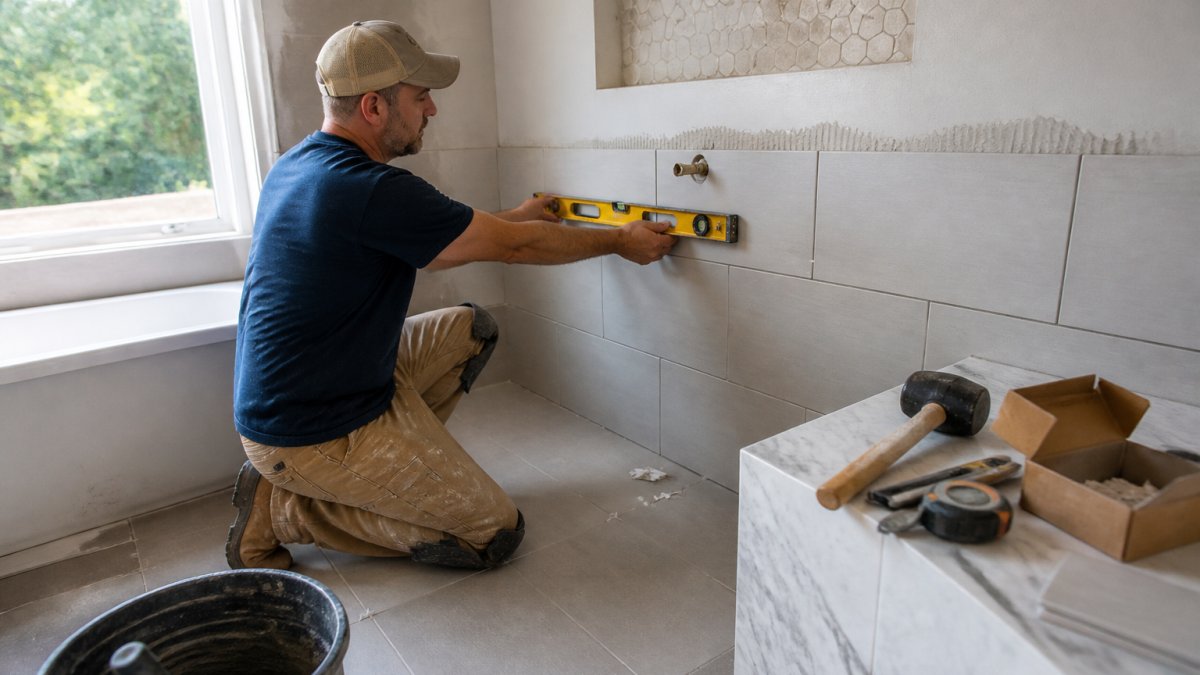
Visit the site at least weekly, look at work in progress, and ask questions, a good contractor welcomes them.
Signs of Poor Workmanship to Watch For
Poor workmanship shows itself in details. Train your eye to spot these issues:
- Uneven surfaces. Floors should be level, walls plumb, and counters flat.
- Gaps and misalignment. Trim should meet walls tightly, grout lines should be consistent, and cabinet doors should align with frames.
- Visible fasteners. Nail heads and screw holes should be filled and sanded smooth, invisible under paint or stain.
- Poor paint quality. Look for drips, runs, brush marks, or uneven coverage. Edges should be clean.
When you spot poor workmanship, document it with photos and bring it to the contractor's attention immediately. Most issues are fixable if caught early.
Permits, Building Codes, and Inspection Requirements
Skipping permits to save money and time is a serious mistake, permits protect you and ensure work meets code.
Permits are required for most renovations, especially bathroom and kitchen work, structural changes, and electrical or plumbing upgrades (Consumer Safety).
Building codes cover electrical wiring, structural support, and ventilation; code-compliant work protects your home and family.
Your local building department schedules inspections at key stages to verify code compliance.
Ask about the inspection schedule and be present if possible, inspectors catch problems others might miss.
Material Selection and Installation Standards
Materials affect durability, appearance, and maintenance, but "buy quality" isn't actionable. Specify materials precisely and verify installation to the manufacturer's standard, the same tile installed wrong will fail regardless of what you paid.
Specify by grade, not by adjective
"Good quality tile" means nothing on a contract. Product grades and standards do. When you review a bid or contract, look for language that names:
- The product and the standard it meets. For tile, that means a porcelain or ceramic rating and a PEI wear rating appropriate to the traffic (floor tile in a busy kitchen needs a higher rating than a wall tile). For paint, a specific product line and sheen, not just "premium paint."
- The substrate and setting materials. Tile bonds to a properly prepared substrate with the right thin-set or mortar, not plywood. The spec should name the substrate, the membrane (if any), and the setting material.
- The installation method. For tile, the trowel notch size, whether back-buttering is required, and the grout joint width. For flooring, the acclimation period and the underlayment.
Ask your contractor to write these into the scope. If they can't explain why a material is specified a certain way, you can't verify work against a standard that was never written down.
Compare grades honestly
Cheap materials fail predictably: budget paint needs extra coats, erasing savings in labor; thin tile chips and shows lippage; laminate can't be refinished, while hardwood can. The mistake is choosing on price alone without understanding the trade-off. Ask for two or three options at different price points for each major material, with the trade-offs stated in writing, then choose based on how long you plan to stay and how much maintenance you're willing to do.
Verify installation against the manufacturer's instructions
Manufacturer instructions are the standard your contractor should follow and your inspection reference. Get written confirmation they'll install to those specs, then check the work at the stages that matter:
- Before tile is set: confirm the substrate is flat and sound, and the correct membrane or backer board is installed.
- During tile setting: check that coverage is full (no hollow-sounding tiles) and grout joints are consistent.
- Before flooring goes down: confirm the subfloor is level within the manufacturer's tolerance and the material has acclimated for the required period.
- Before paint: confirm the surface is properly prepped and primed as the product requires.
If a contractor can't produce the manufacturer's instructions or explain how they're following them, slow down, poor installation ruins quality materials, and the failure often shows up months later, after they've been paid.
What to Do if You're Unhappy With the Work
First, document everything with clear photos and specific, factual notes.
Your home is one of your biggest investments, and poor quality work damages it for years.
At JB's Construction LLC, we deliver quality work, clear communication, and fair pricing.
Ready to start your renovation the right way? Get a free estimate from JB's Construction LLC and see how we can help.
Frequently Asked Questions
What are the most common signs of poor workmanship in a home renovation?
Poor workmanship often shows up as uneven surfaces, visible gaps in tile or trim, misaligned fixtures, caulking that's cracked or poorly applied, paint drips or uneven coverage, and doors or cabinets that don't close smoothly. Check grout lines for consistency, inspect corners for square alignment, and run your hand along surfaces to feel for bumps or dips. Sloppy demolition prep, dust everywhere, damage to surrounding areas, is also a red flag for quality control throughout the project.
How often should I inspect renovation work while it's underway?
Inspect at least weekly, more frequently during critical phases like framing, electrical, plumbing, and finish work. Walk the site before and after major milestones. Take photos and notes of any concerns. A good contractor will expect this and welcome your presence. If you notice issues early, they're cheaper and easier to fix before the next phase begins. Don't wait until everything is done to raise concerns, by then, corrections may require costly rework.
What should I look for when choosing a remodeling contractor to avoid poor quality work?
Ask for references from completed projects and actually call them. Request photos of past work. Verify they're licensed and insured, check with your state licensing board. Get multiple bids and be wary of the cheapest option; it often signals corner-cutting. A quality contractor will give you a detailed, written estimate that accounts for labor, materials, permits, and unexpected costs. They should communicate clearly about timelines and be willing to explain their process and material choices.
What should a home renovation contract include to protect me?
Your contract must include a detailed scope of work, itemized costs, start and completion dates, payment schedule (never pay in full upfront), warranty terms, and a change-order process for any work outside the original scope. It should specify material brands and grades, installation standards, cleanup responsibilities, and how disputes will be resolved. Include a clause requiring the contractor to obtain all necessary permits and pass required inspections. A clear contract prevents misunderstandings and gives you recourse if work falls short of agreed standards.